Alliance and collaborative contracts share risk between the owner and contractor through pain/gain arrangements. For that to work, the alliance needs to know not only what has been spent, but why cost has moved from the tender. Project cost verification answers the first question. Project cost reconciliation answers the second, and gives both the client and the contractor a clearer, shared view of cost.
What project cost verification does
Cost verification, usually carried out by an auditor or verifier, confirms that claimed costs are genuine, correctly coded and reimbursable. It gives the owner financial assurance that money spent was spent on the project.
What it does not show
A verified cost shows that money was spent, not why more or less was spent than the tender assumed.
Design development versus scope change
Some design growth is normal development within the original scope; some is genuine scope change. Both appear as verified cost and are hard to tell apart without reference to the tender scope.
Tender assumptions versus delivery conditions
Tender estimates rely on assumptions such as production rates and supplier quotes. When delivery differs, the cost is real and verifiable, but the ledger does not show which assumption moved.
Without this separation, the alliance sees a single figure for cost growth, and pain/gain and risk-share discussions have little to work with.
What project cost reconciliation adds
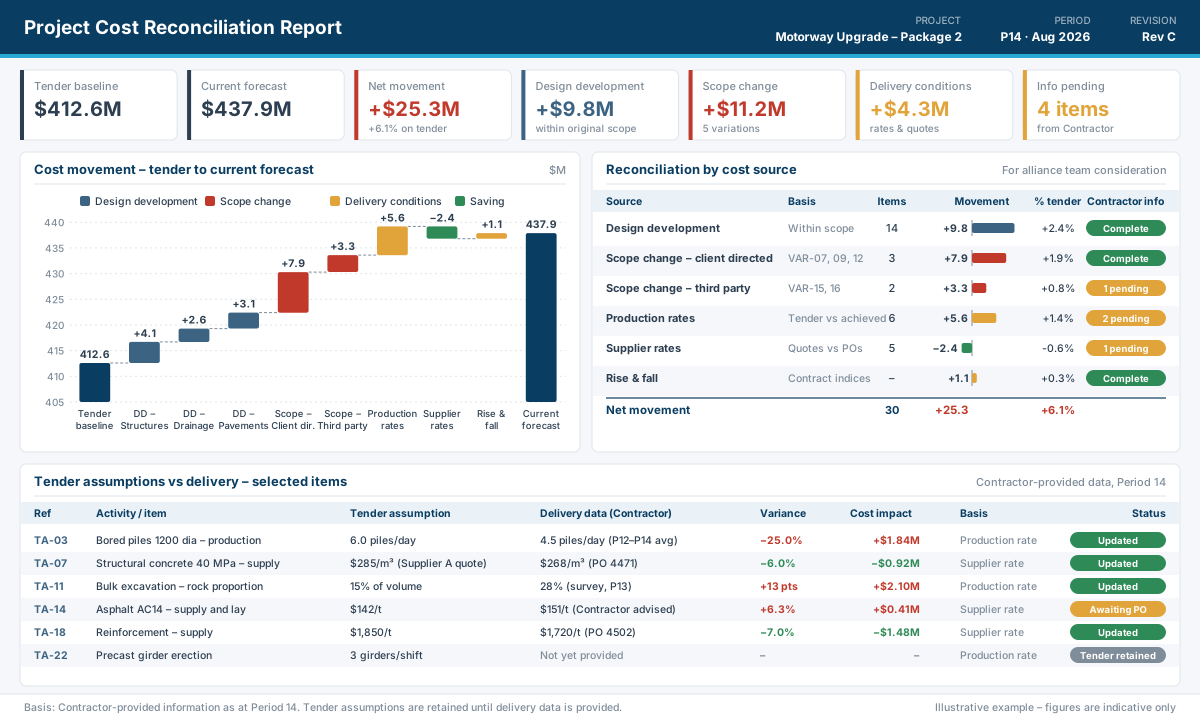
Cost reconciliation keeps the tender estimate as a live baseline through delivery and separates cost movement by source:
- Design development – growth within the original scope
- Scope change – client-directed and third-party variations
- Delivery conditions – production rates, supplier rates and rise and fall against tender assumptions
Benefits for the client
- Transparency – a clear view of why cost has moved, not just how much has been spent.
- Visibility of its own decisions – the cost of client-directed changes and scope clarifications is shown separately.
- Earlier decisions – cost movement is visible while design and scope can still be influenced.
- A fair basis for pain/gain – movement is attributed by source rather than treated as a single overrun.
Benefits for the contractor
- Early identification of design creep – growth beyond the tender scope is differentiated from normal design development as each design package is issued.
- Probable scope variations flagged early – changes arising from design reviews and post-tender scope clarifications, whether negotiated or directed by the client, are captured as they emerge.
- Discrete client changes captured – scope changes proposed by the client are costed and recorded separately.
- Tender assumptions tracked – differences in production rates and supplier prices are recorded against the assumptions they relate to.
- A stronger position in pain/gain and risk-share discussions – supported by a documented, consistent record of cost movement.
How the two work together
| Project cost reconciliation | Project cost verification | |
|---|---|---|
| Question answered | Why has cost moved from the tender? | Are these genuine project costs? |
| Reference point | Tender estimate, scope and assumptions | Invoices, ledgers, agreement terms |
| Typical background | Estimating and cost planning | Audit and finance |
| Output | Cost movement by source | Confirmed actual cost |
| Used for | Alliance review, pain/gain and risk share | Payment and financial assurance |
What reconciliation relies on
Reconciliation relies on the contractor to identify design changes and variations, and to provide delivery data such as achieved production rates and purchase order prices.
TAC separates and reports the cost of each movement using the information the contractor provides. We do not audit that information or decide what is a valid variation – those remain matters for the alliance team.
When to start
As early as possible – ideally at contract award, before the design phase gets underway. Setting up the tender estimate as a structured, linked baseline at this point means design development, scope clarifications and early client changes are captured from the first design review. Reconciliation then continues throughout contract delivery as construction data becomes available. Starting later is possible, but earlier movements have to be reconstructed and are less precise.
In summary
- Project cost reconciliation reports cost movement by source against the tender baseline.
- Project cost verification confirms that actual costs are valid.
- For the client, it brings transparency and earlier visibility of scope decisions; for the contractor, it identifies design creep and probable variations early.
- Starting before design gets underway, and continuing through delivery, gives the alliance a clearer basis for pain/gain and risk-share discussions.